
Tao Te Ching · Part 3, With other people · Idea 9 of 12

Let Them Say We Did It

Lao Tzu on the leader people hardly notice. From Tao Te Ching by Lao Tzu, about the 4th century BC.

Download on theApp Store
The whole story is in Counsel.
About a minute.
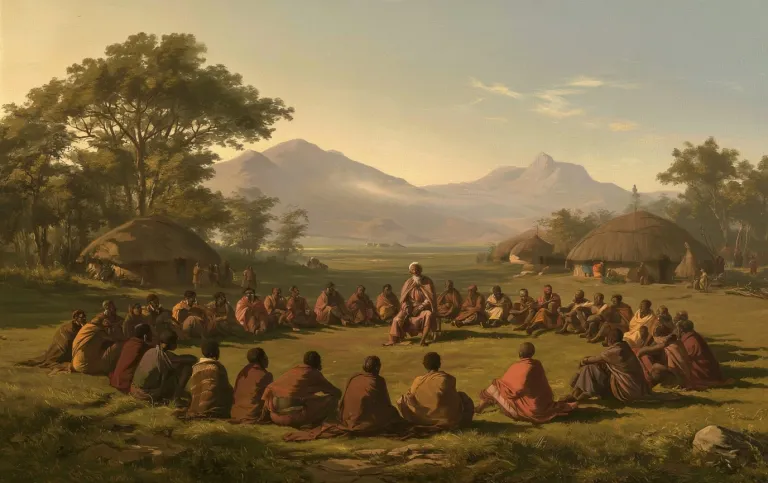
A painting for Let Them Say We Did It

Where it comes from.

An old Chinese legend is set in the reign of Yao, a sage-king of the distant past. An old man was playing a game in the road. A passerby praised the king’s great goodness.

The old man answered with a song. He worked at sunrise and rested at sunset, dug his own well and plowed his own field. What did the king’s power have to do with him?

3 more screens in the appThe rest of the story, and where it turns up in your own week.
The idea in short

Chapter 17 of the Tao Te Ching describes four kinds of rulers: those people hardly notice, those they love, those they fear, and those they despise. When the best finish their work, people say it was their own doing. Nelson Mandela saw this in the regent who raised him, who listened first and spoke last.

The best leaders leave people saying, “We did it ourselves.” Practical advice: in your next meeting, ask your questions first and give your view last.

Likely, on the evidence · checked against 10 sources

Make it yours.

Make it your step

In your next meeting, ask your questions first and give your view last.

Ask your council

“I lead a small team and keep jumping in to fix everything. How do I step back?”

Sources.

  1. The Tao Teh King, or the Tao and its Characteristics, translated by James Legge, Attributed to Lao Tzu (Project Gutenberg), 1891The text
  2. Laozi, Stanford Encyclopedia of Philosophy, 2025
  3. Lunheng, chapter 60 (Xu song), Chinese text, Wang Chong (Wikisource), 80The text
  4. Ji rang ge (the song of the ground-beater), from Gushi yuan, with the Diwang shiji account, Wikisource, 2026The text
  5. Emperor Yao, Wikipedia, 2026
  6. Nelson Mandela: The Making of a Leader, Richard Stengel, TIME, 1994
  7. Nelson Mandela, Wikipedia, 2026
  8. Long Walk to Freedom, Nelson Mandela, 1994
  9. Laozi, Wikipedia, 2026
  10. HBS Faculty Remember Nelson Mandela, Harvard Business School Working Knowledge (Linda A. Hill), 2013

Tao Te Ching, in 12 ideas.

  1. 1
    Use the Empty SpaceLao Tzu on why the empty part makes a thing useful
  2. 2
    Subtract Something DailyLao Tzu on getting better by taking things away
  3. 3
    Know When It’s EnoughLao Tzu on the trouble with never having enough
  4. 4
    Stop Before It SpillsLao Tzu on stepping back when the work is done
  5. 5
    Start With One StepLao Tzu on why every big thing starts small
  6. 6
    Turn the Fish OnceLao Tzu on why too much change spoils good work
  7. 7
    Get Off Your TiptoesLao Tzu on why showing off makes you less steady
  8. 8
    Let the Mud SettleLao Tzu on why a churned-up mind clears when you stop stirring it
  9. 9
    Let Them Say We Did ItLao Tzu on the leader people hardly notice
  10. 10
    Stop Sending the BillLao Tzu on holding a debt without pressing for it
  11. 11
    Trust the Plain WordsLao Tzu on sincere words and fine-sounding ones
  12. 12
    Keep the Three TreasuresLao Tzu on gentleness, thrift and not pushing to be first
Tonight’s read is free

Read the rest in Counsel.

Let Them Say We Did It and the other 11 ideas of Tao Te Ching, a minute at a time.

Download on theApp Store

Every idea is drawn from the public-domain text, and its names, dates and quotes are checked against the sources listed with it. The paintings are made for Counsel; they show the scene, not a historical record.

CounselTonight’s read is freeGet